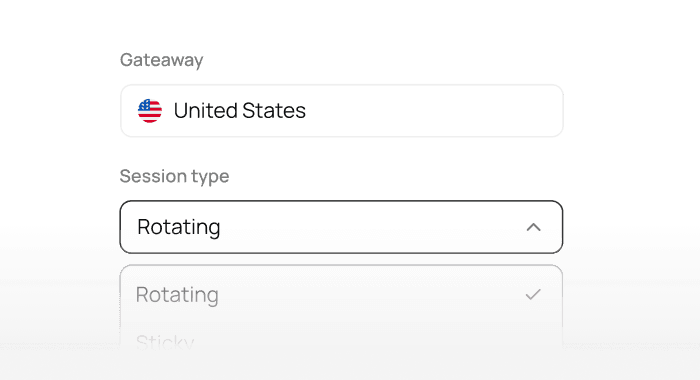
United States

Residential proxies use IPs from residential networks and are built for rotating or location-based access. Datacenter proxies use server-hosted IPs for high-volume requests. ISP proxies combine an ISP-assigned IP with a static connection, giving them the option to choose when you need to keep the same IP across sessions.
| Attribute | ISP proxies | Residential proxies | Datacenter proxies |
|---|---|---|---|
| IP source | ISP-assigned | Residential networks | Datacenter infrastructure |
| Session type | Static | Rotating or sticky | Rotating or sticky |
| Cost model | Per IP | Per GB | Per GB |
| Bandwidth | Unlimited | Traffic-based | Traffic-based |
| IP access | Shared or dedicated | Shared pool | Shared pool |
| Best for | Keeping the same IP across sessions | Rotating and location-based requests | High-volume requests |