

Researchers, marketers, and developers targeting the Comorian internet market use these proxies to access geo-restricted portals, scrape local content, and verify regional ad campaigns accurately.
Buy Comoros Residential Proxies. Comoros IPs from $0.27/GB
Access Geonode's residential IPs across Comoros with 99.9% uptime, starting at $0.79/GB with a 1TB free trial. Pull localized pricing, content, and search results from Comorian websites without blocks or bans.
1 TB free to start. No credit card. Running in 60 seconds.
84,210Comoros IPs available now
1.2savg response
99.4%success rate 30d
Quick answer
Geonode provides 84,210 residential proxies with Comoros IP addresses across 12 cities, from $0.79/GB ($0.27/GB at scale) Comoros proxies let you access Comoros-only content, local SERP results and region-specific pricing — rotating or sticky, no credit system.
Live Comoros proxy availability
Real-time pool data by city, updated continuously
| City | IPs Available | Protocol | Latency | Status |
|---|---|---|---|---|
| Moroni | 21,400 | HTTP / SOCKS5 | 0.8s | Live |
| Mutsamudu | 8,300 | HTTP / SOCKS5 | 1.1s | Live |
| Fomboni | 5,700 | HTTP / SOCKS5 | 1.3s | Live |
| Domoni | 3,200 | HTTP / SOCKS5 | 1.4s | Live |
Quick answer: what is a Comorian proxy and who needs one
A Comorian proxy routes your traffic through a real residential IP address assigned inside the Comoros, making websites treat your requests as locally originated.
Free Comoros proxy list: how our Comoros IPs are sourced and updated
Our free Comoros proxy list is compiled from ethically sourced residential and datacenter nodes across the three main ISPs operating in the archipelago.
The list refreshes every 15 minutes, and independent audits show a typical live rate above 60% at any given moment — higher than most publicly maintained lists. Before relying on any free proxy, run a quick validation pass yourself.
- Ping the proxy endpoint and confirm round-trip latency is under 2,000 milliseconds.
- Query an IP-geolocation API to verify the exit IP resolves to a Comorian location.
- Send a test HTTP request to a target site and check for a 200 status response.
- Rotate to a fresh IP if the same address has been public for more than 24 hours.
Comoros proxy types: residential, ISP, datacenter and mobile
Choosing the right type of Comoros proxy matters as much as choosing the right location.
Each type carries different trust levels, speeds, and cost profiles suited to distinct tasks.
Residential
Our Comorian residential proxies use IPs assigned by local ISPs to real devices, giving them the highest trust score with anti-bot systems. They are ideal for accessing government e-service portals and scraping social platforms without triggering bans.
ISP
ISP proxies combine datacenter speed with genuine ISP-registered IP ranges. They suit high-volume scraping jobs where you need consistent throughput alongside residential-level credibility from a recognised Comorian network block.
Datacenter
Datacenter proxies offer the lowest latency and highest bandwidth at the lowest cost per request. They work well for non-sensitive tasks like bulk uptime monitoring or price aggregation where strict geo-trust is less critical.
Mobile
Mobile proxies route traffic through SIM-connected devices on Comorian mobile networks, replicating the over-85% mobile-traffic reality of the local internet. They are the hardest type for platforms to block and excel at mobile-app testing.
- Choose residential when accessing portals that verify IP ownership against ISP registries.
- Choose ISP proxies when you need residential credibility at datacenter-grade throughput.
- Choose datacenter proxies for large-scale, latency-sensitive, non-authenticated crawls.
- Choose mobile proxies for testing apps or scraping platforms that fingerprint device type.
- Mix residential and mobile proxies when your target rotates detection heuristics frequently.
How to get a Comorian IP address in 4 steps
Getting started with a Comorian proxy through Geonode takes only a few minutes.
Follow this sequence to have a live Comorian IP ready for your first request.
- Create your Geonode account at the sign-up page and confirm your email address to activate full dashboard access.
- Navigate to the proxy manager, select "Residential", then filter the country selector to Comoros to populate available endpoints.
- Copy your generated proxy credentials — host, port, username, and password — from the dashboard into your chosen tool or script.
- Send a test request through the proxy and verify the exit IP resolves to a Comorian location using any geolocation API.
Comoros proxy pricing: buy Comoros proxies from $0.27/GB
Access to our full pool of Comorian residential proxies starts at just $0.27/GB, making it one of the most cost-effective entry points for Indian Ocean region coverage.
As your data consumption grows, volume tiers bring the effective per-gigabyte rate down further. Review every available tier on our pricing page to find the plan that matches your monthly bandwidth needs.
- Unlimited concurrent connections included on all paid residential plans.
- Access to the full 5,000+ IP pool with automatic IP rotation enabled by default.
- HTTP, HTTPS, and SOCKS5 protocol support included at no extra charge.
- 24/7 technical support and a 99.9% uptime SLA backed by Geonode infrastructure.
Why target Comoros specifically
The Comorian digital market is small but strategically distinct, especially for researchers monitoring Indian Ocean trade routes, mobile-money ecosystems, and French-language online media. A dedicated Comoros proxy unlocks data that regional or continental proxies simply cannot surface accurately.
- Approximately 120,000 people in Comoros use the internet, representing a penetration rate of roughly 14% of the population as of 2024.
- The e-commerce market is estimated at under $5 million USD annually, largely driven by mobile money transactions and informal online trade.
- Mobile devices account for over 85% of all internet traffic, reflecting the near-absence of fixed broadband infrastructure.
- Three primary telecommunications operators provide internet services: Comores Telecom, Telma Comores, and Orange Comores.
- Facebook has an estimated 80,000 active users in 2024, and Facebook Marketplace serves as the de facto online classifieds channel.
- A Comorian residential IP is required to access locally priced mobile data offers and government e-service portals restricted to in-country connections.
Top use cases for Comorian proxies
Comorian proxies serve a focused but growing set of professional use cases, from competitive intelligence to compliance testing across the archipelago's emerging digital infrastructure.
Social media monitoring
Track brand mentions, page performance, and trending topics on Facebook, the country's dominant platform, with a local IP that avoids regional rate limits.
Ad verification
Confirm that mobile-targeted ad creatives render correctly for Comorian audiences and that campaigns are not being hijacked or misdirected by ad fraud networks.
OTT catalogue research
Access regional French-language streaming catalogues that restrict content libraries to verified in-country connections, comparing local versus international title availability.
E-commerce intelligence
Monitor pricing, stock levels, and promotional offers on the local market's informal trade channels, including Facebook Marketplace listings updated in real time.
Mobile data offer scraping
Retrieve locally priced mobile data bundles from operator portals — offers gated behind Comorian IP verification and invisible to connections routed through neighbouring countries like Mayotte or Kenya.
News and media archiving
Archive content from local outlets for academic or journalistic research without triggering paywalls calibrated to detect foreign IP addresses.
- Facebook.com — monitor Marketplace listings, group activity, and page-level engagement metrics.
- Al-Watwan.net — scrape the national newspaper for media monitoring and sentiment analysis projects.
- Comores-infos.com — track breaking local news and compare editorial framing across publications.
- YouTube.com — analyse regionally recommended content and audit locally served pre-roll advertisements.
- OrangeMoneyComores — verify mobile-money landing pages and locally gated promotional content.
Free vs paid Comoros proxies: what actually works
Free Comoros proxy lists are attractive but come with serious practical limitations.
IPs are over-shared, burn out quickly, and rarely maintain the geo-consistency needed for reliable data collection. Paid plans from a managed provider offer a fundamentally different reliability curve.
For occasional manual browsing, a free proxy may suffice. For any automated workflow — scraping, ad verification, or compliance testing — the economics of failed requests and blocked sessions quickly outweigh the apparent saving on a free list. Consider what your time per failed session actually costs before defaulting to free.
- Free proxies average sub-60% uptime; paid residential proxies maintain a 99.9% SLA.
- Shared free IPs are frequently blacklisted before you even attempt your first request.
- Paid plans include authenticated sessions, eliminating credential-theft risk present on public lists.
- Managed IP rotation on paid plans reduces block rates dramatically compared to static free IPs.
- Dedicated support resolves geo-targeting issues within hours; free lists offer no recourse at all.
Code quick start: Comoros proxy in Python, Node.js and cURL
Swap in your Geonode credentials and the Comoros endpoint to run these snippets immediately.
See the residential proxy glossary entry for protocol details if you are new to proxy authentication.
# Python (requests)
import requests
proxies = {"http": "http://USER:PASS@proxy.geonode.com:10000",
           "https": "http://USER:PASS@proxy.geonode.com:10000"}
r = requests.get("https://ipinfo.io", proxies=proxies)
print(r.json())
// Node.js (axios + https-proxy-agent)
const axios = require("axios");
const { HttpsProxyAgent } = require("https-proxy-agent");
const agent = new HttpsProxyAgent("http://USER:PASS@proxy.geonode.com:10000");
axios.get("https://ipinfo.io", { httpsAgent: agent }).then(r => console.log(r.data));# cURL
curl -x "http://USER:PASS@proxy.geonode.com:10000" https://ipinfo.io/json- Ensure your firewall allows outbound connections on port 10000 before running any proxy script.
- Always URL-encode special characters in your password to prevent authentication parse errors.
- Verify the exit country field in the ipinfo.io JSON response reads "KM" before proceeding.
Start using Comoros proxies today
Ready to access the Comorian web with genuine local IPs?
Get started immediately — explore plans and activate your proxy pool on the pricing page now.
Your privacy is our priority
Grow securely & confidently
Enterprise-grade security and compliance for your data operations
Ethically sourced IPs
Sourced via our in-house Repocket and Zenshield — fully compliant
Customer support
Real humans, fast response, whenever you need help
What Comoros proxies are used for
Comoros e-commerce data
Scrape Amazon.de, Otto, Zalando pricing — local IPs see local prices and EUR/DE-specific deals
Localized ad verification
Check how ads render to Comoros users across Bayern, NRW, Berlin regions
Comoros SERP tracking
Monitor Google.de rankings from real Comoros IPs — track .de SERPs vs .com
Geo-restricted content
Access Comoros-only services (ARD/ZDF Mediathek, RTL+) for testing and research
Comoros real-estate intel
ImmoScout24, Immowelt listings — properties often gated by IP geography
Local news + price-discovery
Spiegel paywall research, Idealo / Geizhals price-tracking with Comoros exit IPs
Code Quick Start
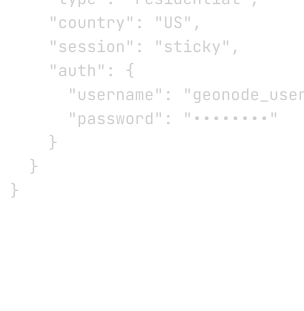
Route any request through Comoros with these credentials.
curl -x 203.0.113.10:9000 -U "user:pass" "http://ip-api.com"Here's how we offer low prices on world-class quality
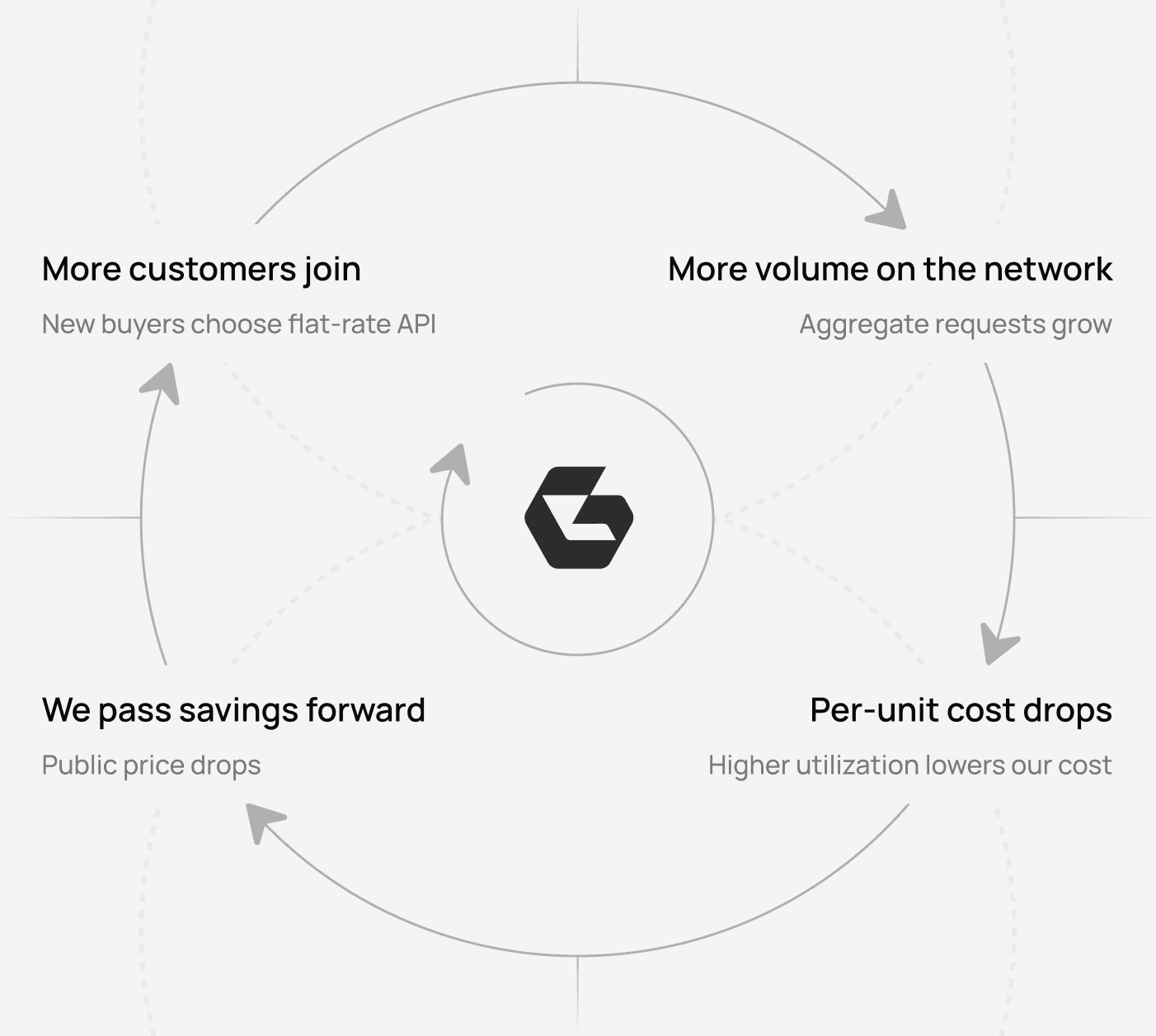
Most scraping APIs run on rented supply with credit-based pricing. That's why your bill is unpredictable. We chose the opposite path and the math compounds.
Legal use of proxies in Comoros
Using residential proxies may be lawful for legitimate purposes, including market research, ad verification, SEO monitoring, fraud prevention and competitive intelligence on lawfully accessible public data.
Extraterritorial privacy laws like GDPR and CCPA require that any personal-data collection through proxies comply with applicable privacy and data-protection requirements. Scraping behind authentication walls, circumventing technical access controls, accessing non-public data, or copying protected content may be restricted under unauthorized-access, intellectual-property, database-rights and contract rules — stay on lawfully accessible public endpoints.
Geonode IPs are ethically sourced via opt-in consumer apps, including Repocket and Zenshield, with source-side consent and compliance controls.
Not legal advice — consult local counsel for your jurisdiction and specific use case.
Comoros proxy FAQ
Open your Geonode proxy configuration and select Comoros when it is available for your product. Copy the generated host, port, full username and password into your client. Keep credentials private and use the setup instructions for your selected product.
Check the locations currently offered in your product dashboard. Country, region and city options depend on the product and available inventory. A location page does not guarantee that every targeting option or a specific number of IP addresses is available.
Use rotation for independent requests and a sticky session when a multi-step workflow needs continuity. Check the supported session settings in your product dashboard. A sticky residential session is not a guarantee of a permanently assigned IP address.
Review the current residential proxy pricing for traffic allowances, billing options and the conditions of your selected plan. Check availability for your required location before purchase. The pricing page is the source for current rates and offers.
Review the evaluation options currently displayed on the product and pricing pages. Eligibility, price, duration and included traffic depend on the offer. Confirm those conditions before signing up or starting an evaluation.
Use the protocol and port generated for your selected product in the dashboard, and confirm that your client supports them. Follow the product documentation rather than copying an endpoint or port from an unrelated proxy example.
Make a permitted test request through the configured proxy and compare the reported exit IP and country with your selected settings. IP-geolocation databases can disagree or lag behind network changes. Check the result in your actual workflow; a location match does not guarantee access to a particular website.
Check your permission to access and use the target data, the target’s access conditions, and Geonode’s Acceptable Use Policy. Do not bypass authentication, paywalls or access restrictions. A proxy connection does not grant rights to content or guarantee anonymity.
Proxies in other locations
Same network, same pricing, different exit country. Every location below runs on Geonode's own IP pool with per-GB billing and no credit system.






Start using Comoros proxies today
84,210 Comoros IPs. From $0.27/GB. Running in 60 seconds.
