

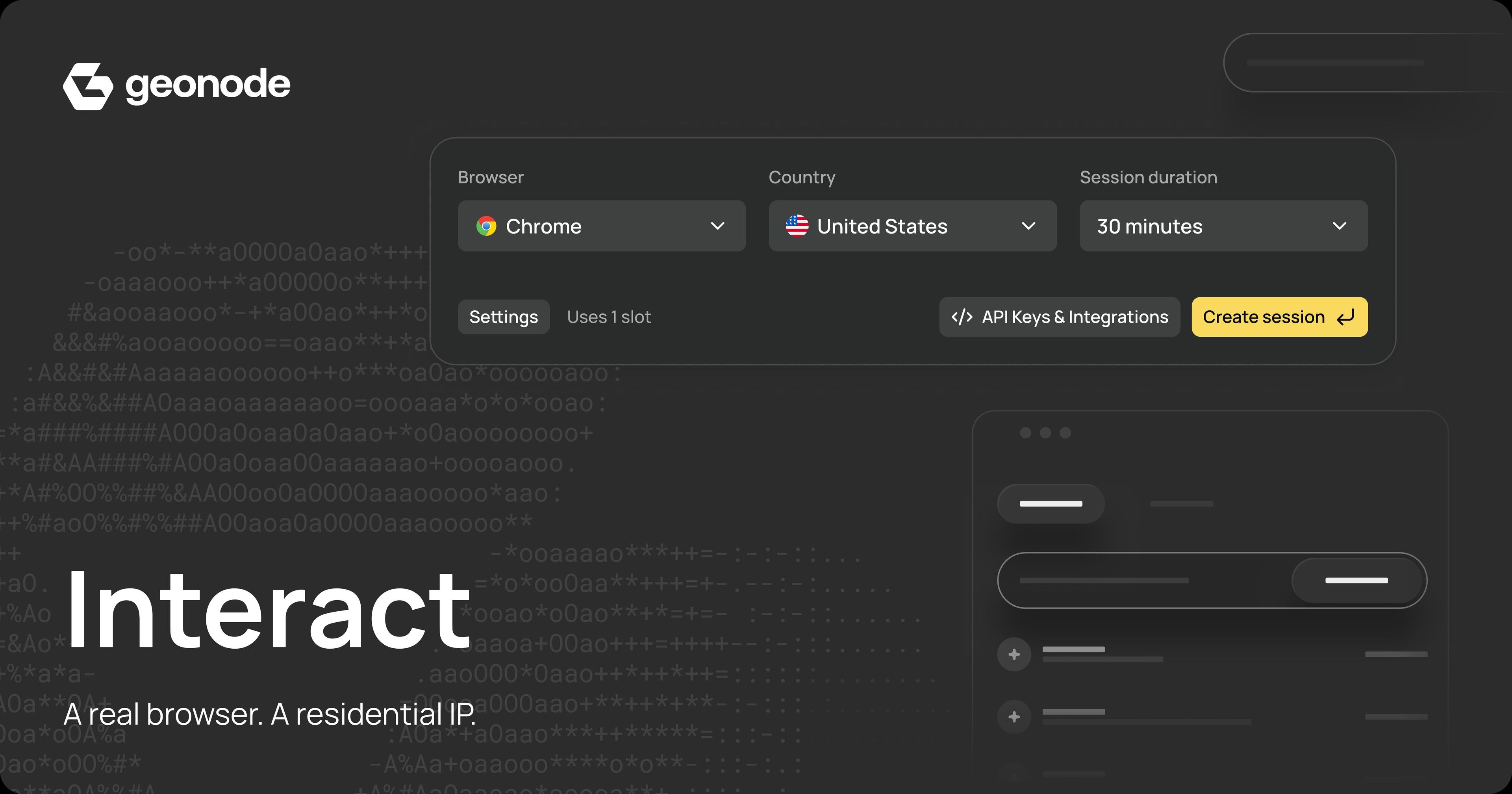
Interact: a real browser on a residential IP, billed by the GB
Interact is live: a real Chrome or Firefox browser on a residential IP, driven by your Playwright, Puppeteer or agent. Billed by the GB, browser hours free.
Tutorials, guides, and close looks from the team
that owns the infrastructure.
Interact is live: a real Chrome or Firefox browser on a residential IP, driven by your Playwright, Puppeteer or agent. Billed by the GB, browser hours free.

Google Search Light: live Google results as JSON or HTML, desktop and mobile at one price, AI Overview in the same call, and no charge for failed requests.

The most reliable way to give an AI agent live web data is to connect it to a tool that fetches the current page at query time: a managed MCP server or a scraping API. Geonode MCP lets Claude, Cursor and other MCP clients fetch live pages without a custom crawler. Residential proxies suit teams that run their own scraper.
A plain-language guide to Janitor AI: how replies are generated, what is free and what costs money, the content rules, what happens to your chats, and why an API proxy and an IP proxy are different things.
A rank tracker API — also called a rank tracking API — is often the right buy instead of raw proxies. This comparison covers pricing, cost modelling, and when to build your own.
A free tier is only useful if you test it on your own URLs. Here is a 48-hour plan: what to measure, how to define success, and a Python script that records success rate and p95 latency.

Datacenter proxies use IPs from hosting networks: fast, usually cheaper, and easier for some sites to detect. Here is how they work, when to use them, and when residential or ISP is the better fit.
"Best proxy provider" depends on the job. This article compares residential providers in depth on pricing terms, expiry and success rate, then points you to ISP and datacenter options when those are the better fit.
There are three ways to get a proxy server: a free public list, a server you run yourself, or a paid residential, ISP or datacenter proxy. Here is how to choose, set one up, and test it.
A proxy server routes your request through another IP address. Here is how it works, which type fits which task, how it differs from a VPN, and how to set one up.
Virtual cards and proxies get recommended together as a privacy setup. They address different halves of the problem, and neither does what most people assume. A virtual card hides your card number from a merchant. It does not hide you. A proxy hides your address from a website. It does not hide your payment. Used together without understanding, they mostly make your legitimate transactions look suspicious.
Website change detection is how you find out that a vendor rewrote a terms-of-service clause, deprecated an endpoint in their docs, or quietly edited a privacy policy before anyone announces it. By the end of this guide you will have a Python script that snapshots a list of pages as Markdown through the Geonode Scraper API, strips the noise, stores every version in SQLite, produces a readable diff, and posts to Slack only when the content really changed. It runs from cron or GitHub Actions and survives flaky fetches. This is deliberately not a price monitor. Prices are numbers in a known slot; documents are prose where the location and shape of a change are unknown in advance. The design choices below follow from that.
Before comparing proxy types for X, it is worth reading what X's own terms say about automated access. They are more explicit than any comparable platform. That reading changes the answer to "which proxies should I buy" for most people, and we would rather lead with it than bury it. What follows: the terms, the `robots.txt`, the narrow set of jobs where proxies remain sensible, and how to choose for those.
Proxies and email automation get bundled together in e-commerce discussions, and the connection is much weaker than the pairing suggests. Email deliverability is governed by domain authentication, sending reputation and recipient engagement. None of those is an IP address you rent by the gigabyte, and sending marketing email through rotating proxies is a pattern that mailbox providers treat as abuse. This guide covers what actually determines whether your email arrives, and the separate set of jobs proxies genuinely do.
Running a capable language model on your own hardware stopped being a novelty some time ago. The question now is which one, on what, and whether you should bother. The honest answer depends far more on your VRAM and your licence requirements than on any benchmark table. Below: the models worth running, the licences that decide whether you can ship them, and the cases where a local model is the wrong choice.

Maksim Lazouski
Published: November 19, 2026

Geonode
Published: November 20, 2026
Geonode Team
Published: November 18, 2026
Geonode Team
Published: September 2, 2026
Geonode Team
Published: November 11, 2026
Geonode Team
Published: November 11, 2026

Carl Gamutan
Published: November 11, 2026
Geonode Team
Published: November 11, 2026

Maricor Bunal
Published: November 11, 2026
Maricor Bunal
Published: November 11, 2026
Geonode Team
Published: September 2, 2026
Geonode Team
Published: October 16, 2026
Geonode Team
Published: September 2, 2026
Geonode Team
Published: September 2, 2026
Geonode Team
Published: September 2, 2026