

Marketers, data engineers, and compliance teams use Switzerland proxies to access geo-restricted content, verify regional pricing, and collect accurate local data without triggering blocks.
Buy Switzerland Residential Proxies. Switzerland IPs from $0.27/GB
Get residential IPs across Switzerland, part of our 7.5M+ monthly active network, with 99.9% uptime and pricing starting at $0.79/GB. Pull accurate local data from Swiss sites without blocks or geo-restrictions slowing you down.
1 TB free to start. No credit card. Running in 60 seconds.
84,210Switzerland IPs available now
1.2savg response
99.4%success rate 30d
Quick answer
Geonode provides 84,210 residential proxies with Switzerland IP addresses across 12 cities, from $0.79/GB ($0.27/GB at scale) Switzerland proxies let you access Switzerland-only content, local SERP results and region-specific pricing — rotating or sticky, no credit system.
Live Switzerland proxy availability
Real-time pool data by city, updated continuously
| City | IPs Available | Protocol | Latency | Status |
|---|---|---|---|---|
| Zurich | 22,000 | HTTP / SOCKS5 | 0.1s | Live |
| Tann | 11,000 | HTTP / SOCKS5 | 0.1s | Live |
| Bern | 11,000 | HTTP / SOCKS5 | 0.1s | Live |
| Geneva | 11,000 | HTTP / SOCKS5 | 0.1s | Live |
Quick answer: what is a Swiss proxy and who needs one
A Swiss proxy routes your traffic through a real IP address registered inside Switzerland, making websites treat your requests as locally originating.
Free Swiss proxy list: how our Switzerland IPs are sourced and updated
Our free proxy list for Switzerland is built by continuously scanning and verifying publicly available Switzerland proxies.
Each entry passes latency, anonymity, and uptime checks before appearing in the list, and the pool refreshes every 10–15 minutes to reflect live status. A typical live rate sits at 40–60%, so validating any IP yourself before use is important. For production workloads, our Swiss residential proxies deliver higher uptime and consistent rotation that a free proxy list simply cannot match.
- Run a real HTTP request through the IP and measure the response time carefully.
- Confirm the exit IP via an IP-geolocation API to verify the country is correct.
- Check the anonymity level — elite proxies hide your original IP most effectively.
- Re-test every few minutes, because free proxy list Switzerland entries expire quickly.
Switzerland proxy types: residential, ISP, datacenter and mobile
Residential Switzerland proxies use IPs assigned by real consumer ISPs such as Swisscom, Sunrise, and Salt.
Residential
Sites perceive them as ordinary home users, making them the hardest type to detect or ban. They are ideal for price monitoring and account management on strict platforms.
ISP
ISP proxies combine datacenter speed with residential legitimacy by using IPs leased directly from local ISPs. You get lower latency than typical residential IPs while still appearing as a genuine subscriber, a strong choice for high-frequency scraping jobs.
Datacenter
Datacenter proxies are the fastest and cheapest option for Switzerland but carry a higher detection risk. They are well-suited for tasks that do not face aggressive bot protection, such as SEO rank tracking or internal QA testing of Swiss-region content.
Mobile
Mobile IPs come from cellular carriers and rotate naturally with each session. Given that mobile drives over 50% of Swiss online retail sessions, mobile proxies are particularly useful for testing app experiences and mobile-specific landing pages.
- Choose residential when the target site enforces strict bot detection or rate limits.
- Use ISP proxies when you need residential-grade trust but require faster throughput.
- Pick datacenter proxies for low-sensitivity bulk tasks to keep costs down efficiently.
- Select mobile proxies when replicating real smartphone user behavior is essential.
- Mix types using IP rotation to spread requests across diverse network fingerprints.
How to get a Swiss IP address in 4 steps
Getting started with a Swiss proxy takes only a few minutes.
Follow these steps to route traffic through a genuine local IP from Geonode's pool.
- Create a Geonode account and navigate to the dashboard to choose your preferred proxy type and Switzerland as the target country.
- Select your authentication method — username/password or IP allowlist — then copy the generated proxy endpoint details to your clipboard.
- Paste the host, port, and credentials into your browser extension, scraping framework, or application's network settings configuration.
- Verify the connection by visiting an IP-geolocation service to confirm your exit IP is correctly located inside the country.
Swiss proxy pricing: buy Switzerland proxies from $0.27/GB
Geonode's entry price for Switzerland proxies starts at just $0.27/GB , making professional-grade Swiss residential proxies accessible even for smaller teams.
As your data volume grows, per-GB costs decrease significantly, so high-volume operations benefit from substantial savings. Visit the pricing page to see the full tier breakdown and calculate your monthly cost.
- Access to over 200,000 residential IPs spread across real local ISPs nationwide.
- Unlimited concurrent sessions so your scraping pipelines never queue or throttle.
- Automatic IP rotation with configurable session stickiness for logged-in workflows.
- 24/7 technical support plus detailed traffic and usage dashboards included by default.
Why target Switzerland specifically
The local market punches well above its geographic size.
Local ISP infrastructure, OTT geo-restrictions, and region-specific pricing on Digitec Galaxus and similar platforms make testing from a real Swiss residential IP genuinely worthwhile — not just convenient.
- About 8 million internet users represent roughly 96% of the total population online.
- Swiss e-commerce is worth approximately US$15 billion in 2025 with exceptional per-capita spend.
- Mobile devices drive over 50% of all online retail sessions in the country.
- Smartphone penetration exceeds 90%, meaning mobile-first testing is commercially critical here.
- Three dominant ISPs — Swisscom, Sunrise, and Salt — shape distinct network fingerprint profiles.
- Digitec Galaxus and Zalando lead local online retail, both deploying region-specific content rules.
Top use cases for Swiss proxies
Price intelligence
Monitor region-specific pricing and promotions on local e-commerce platforms without your scraper being flagged or redirected to a different regional storefront.
Ad verification
Confirm that your display and search ads render correctly for users browsing from the country, catching geo-targeting errors before they waste budget.
SEO rank tracking
Retrieve accurate local SERP positions from a genuine local IP rather than relying on unreliable VPN endpoints that search engines already recognize and discount.
Streaming & content QA
Test OTT availability windows and subtitle localization for content licensed specifically for the local market, using a real residential exit node.
Brand protection
Detect counterfeit listings and unauthorized resellers on local platforms the same way an actual consumer in the country would encounter them organically.
App & UX testing
Simulate real user sessions on mobile and desktop to catch localization bugs, currency formatting errors, and checkout flow issues before launch.
Key platforms to scrape with a Swiss web proxy include:
- Digitec Galaxus — the country's largest online retailer, with strict bot-detection layers.
- Zalando — enforces region-specific catalog rules and local-currency pricing for visitors.
- Amazon (DE) — serves many local shoppers and applies geo-specific promotions and delivery options.
- Ricardo — the leading local auction and classifieds marketplace, valuable for resale price data.
- Microspot — a mid-size electronics and home retailer with competitive pricing worth monitoring regularly.
Free vs paid Switzerland proxies: what actually works
Free proxy Switzerland lists look appealing, but the operational reality is frustrating.
Free IPs are shared among thousands of concurrent users, so speeds collapse under load and target sites ban entire subnets within hours. Paid Switzerland proxies from a managed pool offer dedicated bandwidth, clean IPs, and guaranteed uptime SLAs that free lists cannot provide. For any workflow requiring consistent data or session continuity — ad verification, account management, or price scraping — the economics of paid proxies become obvious within the first failed free-proxy session. Explore our residential proxy plans for a reliable alternative.
- Free proxies are banned at the subnet level frequently, interrupting long-running scraping jobs.
- Shared free IPs expose your requests to the behavioral fingerprints left by other abusive users.
- Paid pools rotate clean IPs automatically, removing the manual re-testing cycle entirely.
- Support and SLA coverage are absent from free options, leaving you to debug failures alone.
- Cost per successful request is often higher with free proxies once retry overhead is accounted for.
Code quick start: Switzerland proxy in Python, Node.js and cURL
Swap in your Geonode credentials and the Switzerland endpoint.
All three examples use authenticated HTTP proxies and exit through a local residential IP.
# Python (requests)
import requests
proxies = {"http": "http://USER:PASS@proxy.geonode.com:10000",
           "https": "http://USER:PASS@proxy.geonode.com:10000"}
r = requests.get("https://ipinfo.io", proxies=proxies)
print(r.json())
// Node.js (node-fetch + https-proxy-agent)
import fetch from "node-fetch";
import { HttpsProxyAgent } from "https-proxy-agent";
const agent = new HttpsProxyAgent("http://USER:PASS@proxy.geonode.com:10000");
const res = await fetch("https://ipinfo.io", { agent });
console.log(await res.json());
# cURL
curl --proxy http://USER:PASS@proxy.geonode.com:10000 https://ipinfo.io
- Ensure your IP allowlist in the dashboard matches the machine sending the requests exactly.
- Use port 10000 for rotating sessions and port 10001 for sticky session persistence instead.
- Set a User-Agent header that matches a real browser to avoid immediate fingerprint-based rejection.
Start using Switzerland proxies today
Ready to access the local market with confidence?
Geonode's Switzerland proxies start at $0.27/GB with no hidden fees and instant activation. View pricing and sign up now to start routing through verified residential IPs.
Your privacy is our priority
Grow securely & confidently
Enterprise-grade security and compliance for your data operations
Ethically sourced IPs
Sourced via our in-house Repocket and Zenshield — fully compliant
Customer support
Real humans, fast response, whenever you need help
What Switzerland proxies are used for
Switzerland e-commerce data
Scrape Amazon.de, Otto, Zalando pricing — local IPs see local prices and EUR/DE-specific deals
Localized ad verification
Check how ads render to Switzerland users across Bayern, NRW, Berlin regions
Switzerland SERP tracking
Monitor Google.de rankings from real Switzerland IPs — track .de SERPs vs .com
Geo-restricted content
Access Switzerland-only services (ARD/ZDF Mediathek, RTL+) for testing and research
Switzerland real-estate intel
ImmoScout24, Immowelt listings — properties often gated by IP geography
Local news + price-discovery
Spiegel paywall research, Idealo / Geizhals price-tracking with Switzerland exit IPs
Code Quick Start
Route any request through a Swiss residential IP using these credentials.
curl -x 203.0.113.10:9000 -U "user:pass" "http://ip-api.com"Here's how we offer low prices on world-class quality
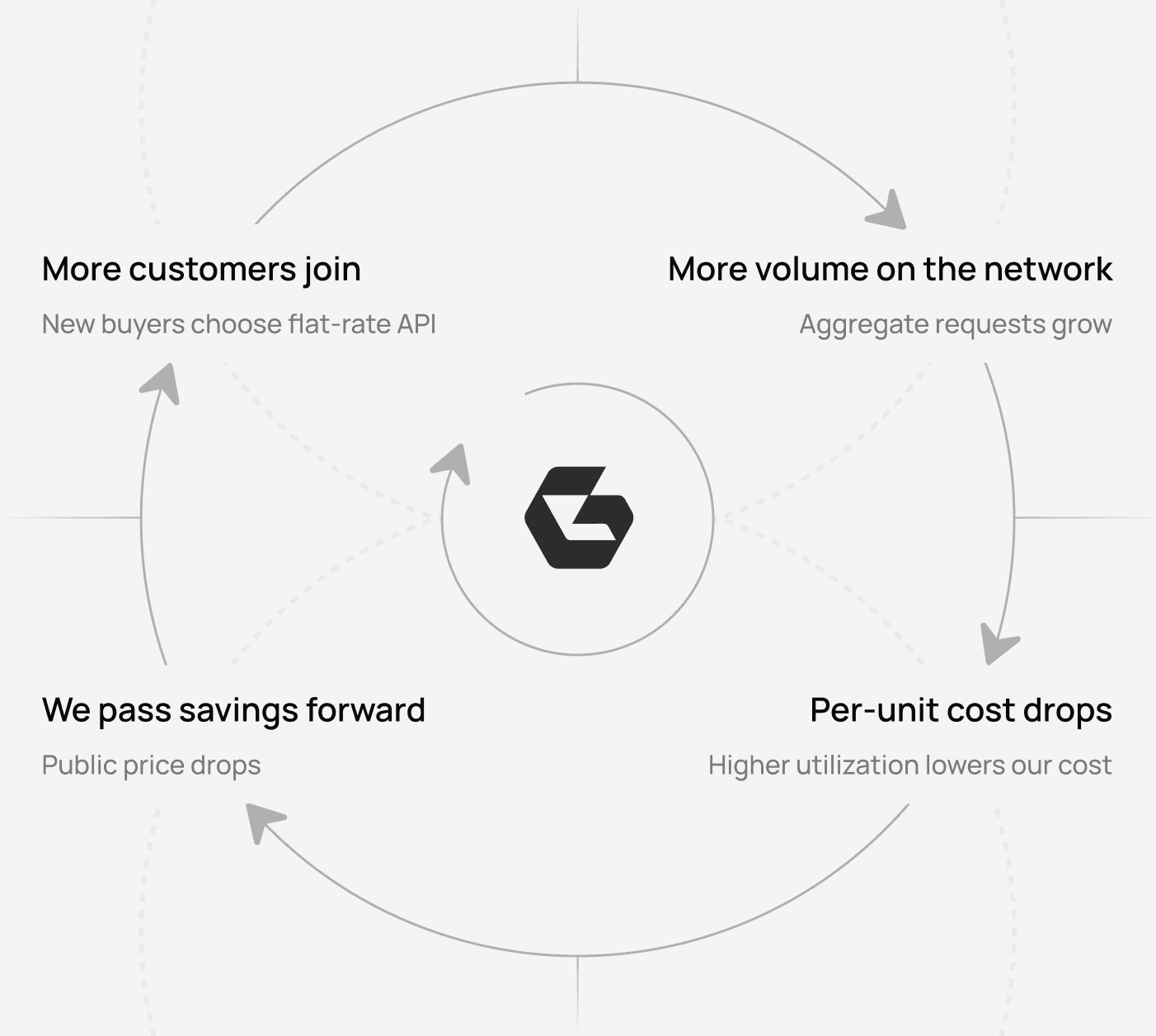
Most scraping APIs run on rented supply with credit-based pricing. That's why your bill is unpredictable. We chose the opposite path and the math compounds.
Legal use of proxies in Switzerland
Using residential proxies may be lawful for legitimate purposes, including market research, ad verification, SEO monitoring, fraud prevention and competitive intelligence on lawfully accessible public data.
Extraterritorial privacy laws like GDPR and CCPA require that any personal-data collection through proxies comply with applicable privacy and data-protection requirements. Scraping behind authentication walls, circumventing technical access controls, accessing non-public data, or copying protected content may be restricted under unauthorized-access, intellectual-property, database-rights and contract rules — stay on lawfully accessible public endpoints.
Geonode IPs are ethically sourced via opt-in consumer apps, including Repocket and Zenshield, with source-side consent and compliance controls.
Not legal advice — consult local counsel for your jurisdiction and specific use case.
Switzerland proxy FAQ
Open your Geonode proxy configuration and select Switzerland when it is available for your product. Copy the generated host, port, full username and password into your client. Keep credentials private and use the setup instructions for your selected product.
Check the locations currently offered in your product dashboard. Country, region and city options depend on the product and available inventory. A location page does not guarantee that every targeting option or a specific number of IP addresses is available.
Use rotation for independent requests and a sticky session when a multi-step workflow needs continuity. Check the supported session settings in your product dashboard. A sticky residential session is not a guarantee of a permanently assigned IP address.
Review the current residential proxy pricing for traffic allowances, billing options and the conditions of your selected plan. Check availability for your required location before purchase. The pricing page is the source for current rates and offers.
Review the evaluation options currently displayed on the product and pricing pages. Eligibility, price, duration and included traffic depend on the offer. Confirm those conditions before signing up or starting an evaluation.
Use the protocol and port generated for your selected product in the dashboard, and confirm that your client supports them. Follow the product documentation rather than copying an endpoint or port from an unrelated proxy example.
Make a permitted test request through the configured proxy and compare the reported exit IP and country with your selected settings. IP-geolocation databases can disagree or lag behind network changes. Check the result in your actual workflow; a location match does not guarantee access to a particular website.
Check your permission to access and use the target data, the target’s access conditions, and Geonode’s Acceptable Use Policy. Do not bypass authentication, paywalls or access restrictions. A proxy connection does not grant rights to content or guarantee anonymity.
Proxies in other locations
Same network, same pricing, different exit country. Every location below runs on Geonode's own IP pool with per-GB billing and no credit system.






Start using Switzerland proxies today
84,210 Switzerland IPs. From $0.27/GB. Running in 60 seconds.
